
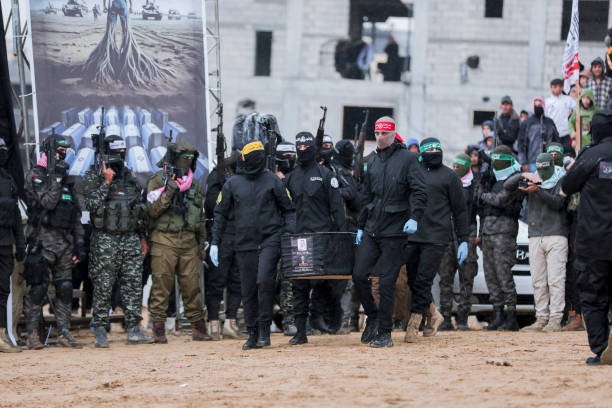
Hamas freed five of the six Israeli hostages expected to be released from captivity in Gaza on Saturday, as a fragile ceasefire strained by mutual accusations approaches the conclusion of its first phase.
Avera Mengistu, a 39-year-old Ethiopian-Israeli man described by his family as mentally ill and held since 2014, and Tal Shoham, 40, were handed over to the International Committee of the Red Cross in a highly orchestrated ceremony in Rafah, southern Gaza.
Shortly afterward, Eliya Cohen, 27, Omer Shem Tov, 22, and Omer Wenkert, 23, were released in Nuseirat, central Gaza. Though they appeared pale and thin, their condition seemed better than some of the other hostages freed this month.
The men were paraded onstage by armed Hamas fighters, seemingly under pressure to wave and smile at the assembled crowd, despite repeated Red Cross requests for discreet and dignified handovers.
Hisham al-Sayed, a 36-year-old Palestinian Bedouin with Israeli citizenship, also described as mentally ill, was expected to be released separately later on Saturday. Mengistu and Al-Sayed had been held by Hamas for nearly a decade after crossing into Gaza voluntarily.
The other hostages were taken during Hamas’s October 7, 2023, attack on Israel, which targeted kibbutzim near the border and a music festival where hundreds of Israelis were killed.
The Israeli military confirmed the releases, stating that all five hostages had been transported into southern Israel by the Red Cross.
In return for all six hostages, Israel is set to free 602 Palestinian prisoners, including hundreds detained without charge or trial and 110 serving life or long sentences for violent offenses against Israelis.
With this latest exchange, Hamas has now released 29 hostages—four of them dead—in return for over 1,600 Palestinian prisoners, a development that could bolster its standing among Palestinians in Gaza despite the severe consequences of its attack on Israel.
These six hostages mark the final group to be exchanged for hundreds of Palestinian prisoners under the first phase of the ceasefire, which is set to conclude on Thursday with the release of four additional bodies.
The second phase, for which negotiations have yet to gain traction, could potentially bring an end to 15 months of war in exchange for the release of around 60 remaining hostages, including male soldiers and others presumed dead.
Israeli Prime Minister Benjamin Netanyahu’s far-right coalition partners strongly oppose a long-term truce and are pushing for the military to resume its war against Hamas.
The six-week ceasefire has repeatedly teetered on the brink of collapse, requiring intervention from the U.S., Egypt, and Qatar to keep it on track. Hamas has accused Israel of blocking humanitarian aid, including heavy equipment to retrieve bodies trapped under rubble, as well as mobile homes and tents for displaced Palestinians.
A recent flashpoint arose earlier this week when Hamas mistakenly released an unidentified body instead of that of Shiri Bibas, a 32-year-old Israeli mother whose two young children were also abducted on October 7. Their bodies were handed over earlier this week.
On Friday, Hamas released another body, later confirmed by Israeli forensic experts as Bibas. Hamas blamed the mix-up on the chaos within war-ravaged Gaza.
In Israel, the Bibas family’s ordeal—their father was freed alive in February during the first hostage exchange—has become emblematic of both Hamas’s brutality and Israeli authorities’ failure to protect them.
The Israeli military announced on Friday that autopsies showed Bibas’s two children were murdered while in Hamas captivity, contradicting Hamas’s previous claims that they were killed in an Israeli airstrike.
Rear Admiral Daniel Hagari, an Israeli military spokesperson, stated that the boys were not shot but were instead killed “with their bare hands” by Hamas, adding, “Afterwards, they committed horrific acts to cover up these atrocities.”
Despite the tense nature of the ceasefire’s first phase, Israel has sent a low-level delegation to Cairo for discussions on the second phase, though progress remains limited. Hamas has signaled its willingness to continue negotiations.
Hamas’s October 7 attack on Israel killed at least 1,200 people and resulted in about 250 hostages, according to local officials. Israel’s subsequent military response has killed nearly 50,000 Palestinians, according to Gaza health officials, leaving the enclave—home to over 2.3 million people—in a deep humanitarian crisis.