
By Muslima Akhtar, Executive editor:
Bangladesh’s aviation sector has made its largest-ever pivot toward the United States in 2026, with both the national flag carrier and its leading private airline placing combined orders for 35 Boeing aircraft worth over $5.2 billion, a move that is as much about trade diplomacy as about planes.
The deals mark a decisive shift away from European manufacturer Airbus and are directly linked to Dhaka’s effort to defuse a growing trade confrontation with Washington.
What was bought?
1. Biman Bangladesh Airlines – 14 aircraft, $3.7bn
On 30 April 2026, Biman signed at the Hotel InterContinental in Dhaka what it called the largest fleet expansion in its modern history.
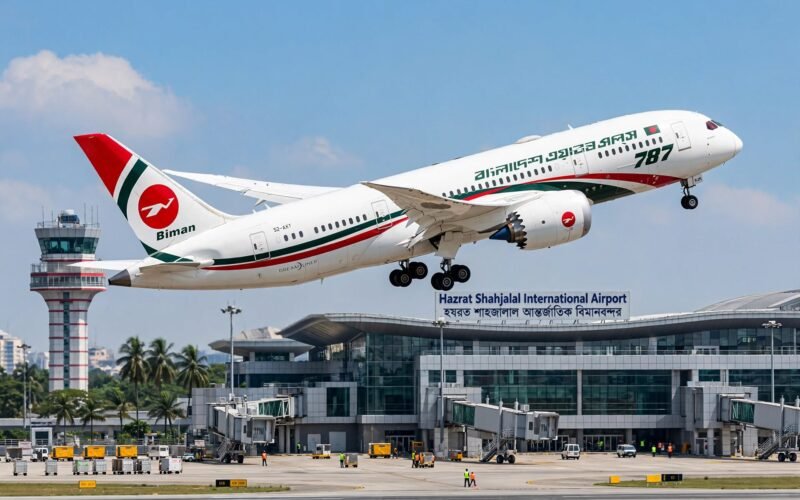
Biman Bangladesh Airlines has signed a landmark agreement with US aviation giant Boeing to purchase 14 aircraft
The order, valued at approximately $3.7 billion at list prices, includes a mix of wide-body Boeing 787 Dreamliners and narrow-body Boeing 737 MAX aircraft. Under the deal, Boeing will supply two 787-9 aircraft, eight 787-10s, and four 737-8s.
It will increase Biman’s fleet from 19 to 33 aircraft within the next decade. Biman Chairman Rumee A Hossain said the new aircraft will raise daily seat capacity to more than 5,000 and increase cargo handling capability.
2. US-Bangla Airlines – 21 aircraft, $1.5bn
Three months later, Bangladesh’s largest private carrier followed.
Bangladesh’s leading private carrier, US-Bangla Airlines, plans to acquire 21 Boeing aircraft in a deal worth about $1.5 billion
The order includes 15 Boeing 737-8 aircraft and six Boeing 737-800s, with deliveries by the end of 2027.
Together, the two orders total 35 jets. The government has separately committed to a headline figure of 25 Boeing aircraft as part of tariff negotiations.
Bangladesh has ordered 25 aircraft from Boeing and ramped up imports of key American goods
Why Boeing, why now? The trade angle
Officials said the decision reflects not only fleet requirements but also larger trade considerations.
Bangladesh faces a roughly $6 billion trade imbalance with the United States. It exports about $8 billion annually to the US, while US exports to Bangladesh amount to about $2 billion.
That imbalance put Dhaka in the crosshairs of the Trump administration’s reciprocal tariff policy. The moves are part of a broader strategy to narrow a $6 billion US trade deficit and avoid a looming 35 per cent tariff hike that has rattled the country’s export sector, especially the garments industry which risks losing competitiveness.
Under the previous Sheikh Hasina government, Bangladesh had approved plans to buy 10 Airbus A350s after lobbying by France and the UK. Following the government’s fall, the interim administration shifted course in favour of Boeing, a move Reuters described as a shift away from Europe’s Airbus amid trade pressure from Washington.
The aircraft deal is part of what US Ambassador Brent Christensen called the “Agreement on Reciprocal Trade, also called the ART”.
To make the $3.7bn deal viable, Washington offered financing:
We’re proud this purchase is being financed by the Export-Import Bank of the United States, with terms that will reduce the burden on Biman’s cash flows that align with aircraft delivery schedules.
The government will provide a sovereign guarantee.
Analytic: Impact and Benefits for Bangladesh Economy
1. Protecting the garment lifeline
The biggest immediate benefit is not aviation at all. By committing to Boeing, wheat, soybeans, LNG and cotton, Dhaka managed to get US tariffs cut from a threatened 35% to 19%, and secured duty-free access for garments manufactured using US cotton. For an economy where RMG is 85% of exports, avoiding the tariff hike preserves an estimated $8bn market and millions of jobs.
2. Stemming foreign currency outflow
Bangladesh’s international air travel market generates an estimated $5.8 billion annually but foreign airlines carry the majority of passengers, resulting in a significant outflow of foreign currency. A larger Biman and US-Bangla fleet aims to recapture that market. More direct flights to the Middle East – where 8 million Bangladeshi migrants live – means remittances travel with lower cost and cargo belly capacity increases.
3. Aviation hub ambition
The purchase coincides with a new third terminal at Hazrat Shahjalal International Airport in Dhaka. State Minister for Civil Aviation M Rashiduzzaman Millat said: “Bangladesh is moving towards becoming a regional aviation hub. The new aircraft of Biman will help achieve that goal.” The 787-10 will bring efficiency to high-demand Middle East routes, while the 787-9 will serve long-haul Europe and North America.
4. Costs and risks
The binding import commitments restrict sourcing flexibility. Critics note Bangladesh committed to importing 3.5 million tonnes of US wheat and 14 Boeing aircraft in the same package, locking in dollar-denominated debt via EXIM at a time of low reserves. Biman has historically struggled with profitability, and dry-leasing interim aircraft while waiting years for Boeing deliveries (global backlog is 5+ years) adds cost.
Bottom line: The Boeing deals are less a simple fleet renewal than a strategic hedge. Bangladesh trades long-term dollar debt and a fleet monoculture (now almost all Boeing) for short-term trade security for its garment sector, cheaper aircraft financing, and a shot at building Dhaka into a transit hub for labor migration and cargo. If Biman can raise load factors above 80% on Gulf and London routes, the $3.7bn bet pays back in forex. If not, it becomes a sovereign liability flying on sovereign guarantee.