
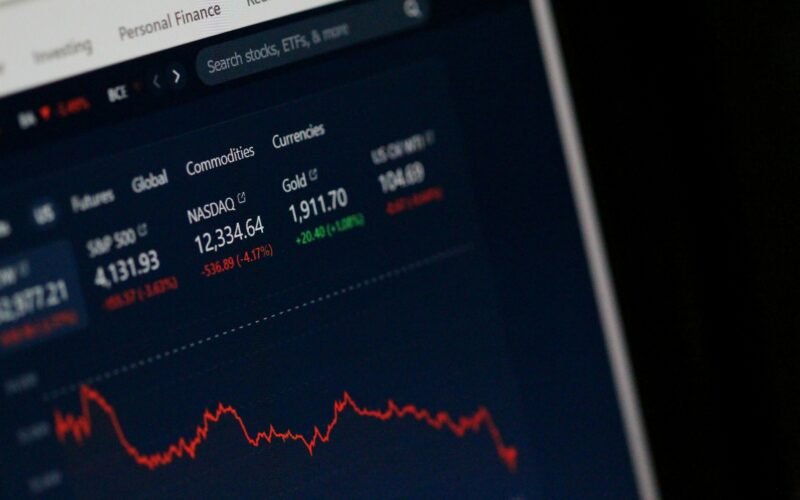
Financial markets all over the world recently experienced significant turmoil, with investors being faced with the challenge of coping with what traders call “bleeding markets”. The significant selloff in high-growth tech equities, the dramatic collapse of cryptocurrencies, and high volatility in major stock indexes were recently seen in the headlines all around the world. This sharp change in investors’ sentiment is a significant contrast to the strong rallies that preceded it, forcing both economic experts and regular market participants to investigate reasons behind the market downturn.
The reason behind the most recent market downturn comes from several reasons that include the influence of the macroeconomic environment and some shifts inside particular sectors. First and foremost, one of the factors behind the market downturn is the ongoing macroeconomic uncertainty related to global monetary policies and interest rates. Central banks are actively fighting inflation, leaving high interest rates in place. High interest rates lead to the decreased present value of future cash flows of companies, thus affecting mainly highly valued tech companies whose operations depend on the cheap access to capital.
Another reason behind the decline in equities is the massive wave of profit-taking within artificial intelligence and semiconductor sectors. Due to their strong valuation gains, market participants are now in doubt about their future profitability. Weak guidance from industry giants and the doubts about the excessive capital expenditures for AI infrastructure development without a direct return have created a broad pullback in those sectors. Due to portfolio rebalancing by large institutions, the selloff quickly spread across global exchanges of North America, Europe, and Asia.
At the same time, the correction within the crypto market was even deeper due to the high interconnection between modern risk assets. Since liquidity was drying up in traditional financial institutions, cryptocurrency assets started experiencing liquidations, sending major crypto-tokens down from their recent highs. The pullback of institutional investors trying to protect their capital in an uncertain macroeconomic environment created a cascading downturn that has led to fears among retail market participants.
However, despite the unpleasant picture, economic historians claim that market declines are an inevitable part of any long-term economic cycle. The valuations that exceeded fundamental economic reality need to be recalibrated in order to set new healthy baseline prices. Analysts state that balance sheets of underlying companies in mainstream non-tech sectors are relatively healthy, which indicates that current decline is simply the result of the new risk adjustment.
In conclusion, it should be stated that although market downturns are challenging and scary experience, they play the role of a necessary reminder of market discipline. They are tests for investors’ strategies, underlining the importance of diversification and proper risk management. As soon as economic data becomes clear and monetary policy becomes clearer, the market will stabilize itself, paving the way for future capital growth.