

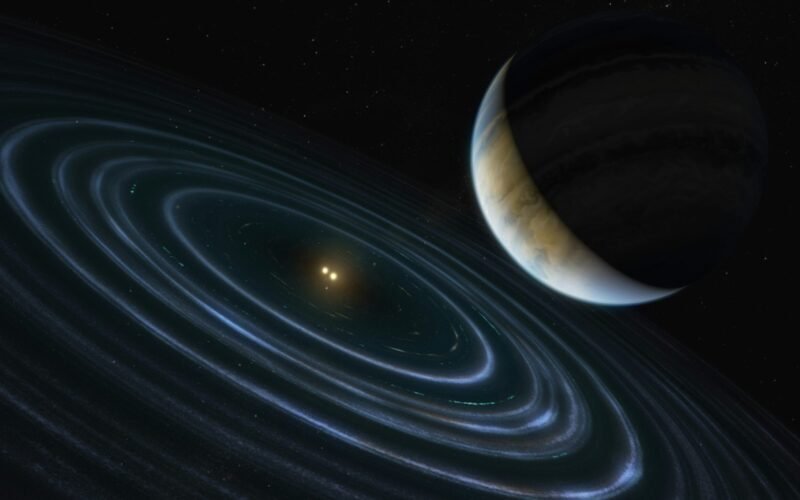
Astronomers using NASA’s James Webb Space Telescope have taken an unprecedented look at a giant planet orbiting the remains of a dead star, providing new clues about how worlds can survive one of the most violent events in the life of a planetary system. The observations of the exoplanet WD 1856 b offer scientists a rare glimpse into what could happen to the outer planets of our own Solar System billions of years from now, when the Sun reaches the end of its life.
Located about 81 light-years from Earth in the constellation Draco, WD 1856 b is a gas giant roughly eight times the mass of Jupiter that circles a white dwarf, the dense stellar remnant left behind after a Sun-like star exhausts its nuclear fuel and sheds its outer layers. According to Reuters, the planet completes a full orbit every 1.4 days and travels around its white dwarf at a distance about 50 times closer than Earth is to the Sun, an unexpectedly tight orbit that has puzzled astronomers since the planet was first discovered in 2020.
The latest observations, published in the journal Nature, represent the first detailed atmospheric study of a planet orbiting a white dwarf. By observing WD 1856 b as it passed in front of its tiny host star, the James Webb Space Telescope measured the composition and temperature of the planet’s atmosphere with extraordinary precision. According to Space.com, the rare transit lasted only about eight minutes, requiring Webb’s exceptional sensitivity to capture the necessary data.
Scientists found that WD 1856 b possesses an atmosphere composed primarily of hydrogen and helium, similar to Jupiter’s, but with unusually high levels of methane. Webb also measured the planet’s atmospheric temperature at approximately 127 degrees Celsius (260 degrees Fahrenheit), considerably warmer than researchers had expected for a world orbiting a cooling white dwarf. According to Reuters, the team believes the planet’s elevated temperature may result from gravitational interactions that occurred as it migrated inward toward its current orbit over billions of years.
The biggest mystery surrounding WD 1856 b is not its atmosphere but how it managed to survive the death of its parent star. Normally, when a Sun-like star enters its red giant phase, it expands dramatically, engulfing or destroying nearby planets before eventually collapsing into a white dwarf. Finding a giant planet orbiting so close to one of these stellar remnants has challenged long-standing theories of planetary evolution.
According to Smithsonian Magazine, the new observations strongly support the idea that WD 1856 b originally formed much farther away from its host star before gradually migrating inward after the star became a white dwarf. Gravitational interactions with other objects in the system likely altered the planet’s orbit over millions or even billions of years, allowing it to settle into the remarkably close orbit observed today.
Researchers continue to evaluate two competing explanations for the planet’s history. One possibility is that WD 1856 b somehow survived being engulfed during the star’s red giant phase before emerging into its current orbit. The second, and increasingly favoured, theory proposes that the planet remained safely beyond the reach of the expanding star and only migrated inward after the stellar transformation had already taken place.
According to Reuters, the system’s unusual architecture may have played an important role in that migration. The white dwarf belongs to a triple-star system that also contains two nearby red dwarf stars. Their gravitational influence could have gradually disturbed the giant planet’s orbit, causing it to spiral inward over immense periods of time without being destroyed.
The observations also demonstrate the unique capabilities of the James Webb Space Telescope. Because the white dwarf is only slightly larger than Earth while the planet itself is many hundreds of times larger in volume, WD 1856 b blocks more than half of the star’s light during each transit. This geometry gave Webb an unusually favourable opportunity to analyse the planet’s atmosphere in remarkable detail.
According to Space.com, this marks one of the first opportunities to study the atmosphere of a planet orbiting a white dwarf through transit spectroscopy. The success of the observations opens the possibility of examining additional planetary systems surrounding stellar remnants, potentially revealing whether surviving planets are more common than previously believed.
Beyond solving a mystery surrounding a single exoplanet, the research offers a possible preview of the distant future awaiting our own Solar System. In roughly five billion years, the Sun is expected to exhaust its hydrogen fuel, expand into a red giant and almost certainly consume Mercury and Venus. Earth’s ultimate fate remains uncertain, while the outer planets are expected to survive in some form after the Sun sheds its outer layers and becomes a white dwarf.
According to Reuters, astronomers believe planets such as Jupiter and Saturn will probably continue orbiting the Sun’s white dwarf remnant, although they are expected to drift farther away as the dying star loses roughly half of its mass. WD 1856 b demonstrates that under the right circumstances, giant planets may not only survive stellar death but could later migrate into entirely new orbits.
Scientists say the findings highlight how planetary systems can remain dynamic long after their stars have died. Rather than marking the end of a solar system’s story, the formation of a white dwarf may trigger new gravitational interactions capable of dramatically reshaping the orbits of surviving worlds. As Webb continues examining similar systems, researchers hope to determine whether WD 1856 b is an extraordinary exception or simply the first example of a surprisingly common stage in the long-term evolution of planetary systems across the galaxy.