

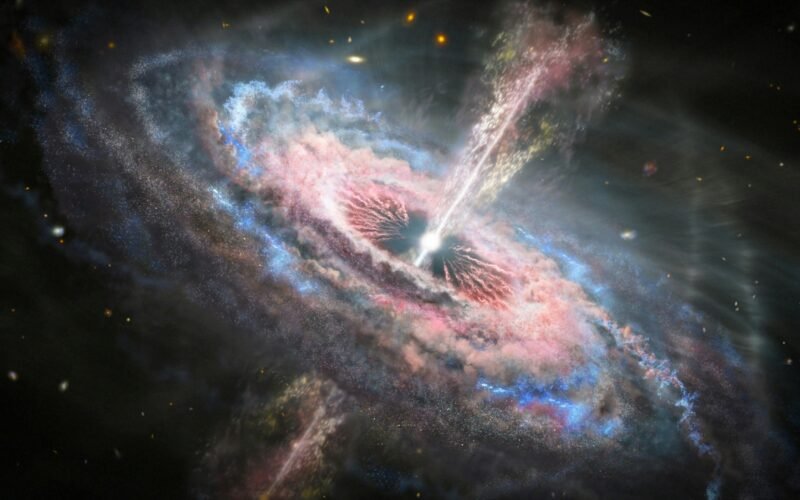
Astronomers have uncovered one of the most remarkable collections of ancient cosmic objects ever observed after the European Space Agency’s Euclid space telescope discovered 31 previously unknown quasars dating back to the universe’s earliest chapter. The findings include the two oldest quasars ever identified, offering scientists an unprecedented glimpse into a period when the universe was only about five percent of its current age and raising new questions about how enormous black holes formed so quickly after the Big Bang.
According to Reuters, the newly discovered quasars date back more than 13.1 billion years, meaning their light began its journey toward Earth only around 670 million years after the Big Bang. At that point in cosmic history, the universe was still emerging from what astronomers call the epoch of reionization, a transformative era during which the first stars and galaxies illuminated the cosmos after the long-lasting cosmic “dark ages.”
Quasars are among the brightest and most energetic objects in existence. They are powered by supermassive black holes located at the centres of galaxies, where enormous amounts of gas and dust spiral inward to form intensely hot accretion disks. As this material falls into the black hole, it releases extraordinary amounts of energy, producing light that can outshine every star within the host galaxy combined.
According to Space.com, the two record-breaking quasars shine with the brightness of roughly one trillion suns despite existing when the universe was still in its infancy. Their incredible luminosity allowed Euclid to detect them across more than 13 billion light-years of space, making them valuable time capsules that preserve information from one of the earliest chapters of cosmic history.
The discovery more than doubles the number of known quasars from this distant era. According to Live Science, astronomers previously knew of only a small handful of quasars dating from this period because finding them required painstaking searches using multiple telescopes. Euclid’s combination of wide-field observations, sharp imaging and sensitive infrared instruments has dramatically accelerated that process, allowing researchers to locate dozens of these rare objects in only the first phase of its survey.
While the discovery represents a major observational achievement, it also deepens one of astronomy’s biggest mysteries. According to Reuters, the existence of such massive black holes so soon after the birth of the universe challenges current theories of black hole formation and growth. Scientists struggle to explain how these objects could have accumulated hundreds of millions or even billions of times the Sun’s mass in such a relatively short cosmic timespan.
Researchers believe there are only two possible explanations, both of which present significant challenges to existing models. One possibility is that the first black holes were born much larger than scientists currently believe is possible. The other is that they somehow grew at extraordinary rates far beyond what present theories predict. Either explanation would require astronomers to rethink important aspects of how the early universe evolved.
According to Space.com, these newly identified quasars provide an important opportunity to investigate the epoch of reionization in greater detail. This period marked the transition from a universe filled largely with neutral hydrogen gas to one where energetic radiation from the earliest stars and galaxies ionised that gas, allowing light to travel freely across space. Understanding what happened during this era remains one of modern cosmology’s central goals.
Euclid was originally designed to investigate two of the universe’s greatest mysteries: dark matter and dark energy. By producing the largest three-dimensional map of the cosmos ever attempted, the mission aims to help scientists understand why the universe is expanding at an accelerating rate and how invisible dark matter influences the formation of galaxies. The unexpected success in discovering ancient quasars has become one of the mission’s most exciting scientific bonuses.
According to Live Science, Euclid has achieved these discoveries after surveying only a fraction of the sky it is expected to observe during its six-year mission. Researchers anticipate that hundreds more ancient quasars could eventually be identified as the telescope continues mapping approximately one-third of the entire sky, providing a far larger sample for studying the earliest generations of galaxies and supermassive black holes.
The discoveries were made using data collected during roughly the first year and a half of the Euclid Wide Survey before being confirmed through follow-up observations from powerful ground-based observatories. The results have been published in the journal Astronomy & Astrophysics, where researchers describe finding quasars with redshifts ranging from 6.6 to 7.8, placing them among the most distant objects ever observed.
For astronomers, the discovery represents far more than simply adding new entries to a catalogue of distant objects. Each newly identified quasar provides another window into a universe that was still taking shape, helping researchers reconstruct how galaxies, stars and black holes evolved during the earliest stages of cosmic history. As Euclid continues scanning deeper into space, scientists hope these ancient beacons will reveal whether current theories can be refined or whether entirely new ideas will be needed to explain how the universe grew up so quickly after its explosive beginning.