

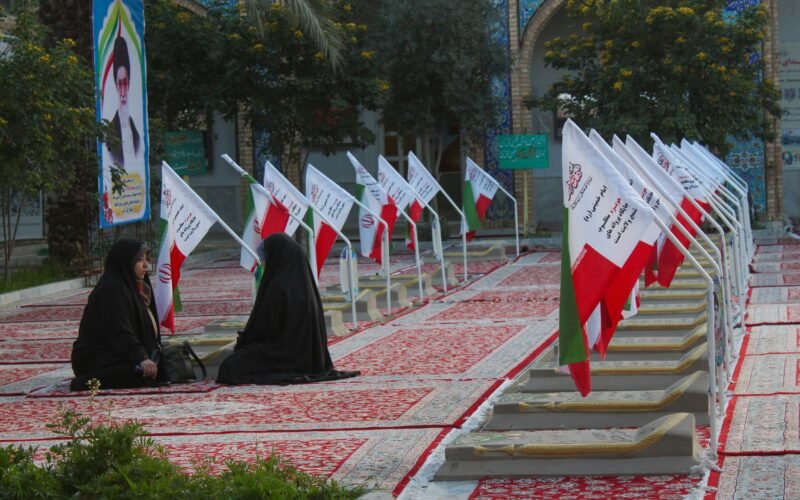
Iran has begun a week of state funeral ceremonies for its late Supreme Leader Ayatollah Ali Khamenei, with thousands of mourners gathering in Tehran as the country embarks on one of the most significant public commemorations in its modern history. The ceremonies, taking place months after Khamenei was killed during the conflict involving Iran, Israel and the United States, are expected to continue through several Iranian and Iraqi cities before concluding with his burial in Mashhad.
According to the Associated Press, senior Iranian political leaders, military commanders, religious figures and members of Khamenei’s family attended funeral prayers at Tehran’s Grand Mosalla mosque, where crowds assembled under heavy security. President Masoud Pezeshkian joined senior officials from the Revolutionary Guard and other branches of government as mourners paid their respects to the man who led Iran for more than three decades.
The Wall Street Journal reported that the funeral has been designed not only as a national farewell but also as a demonstration of resilience by Iran’s leadership following months of conflict and political uncertainty. Authorities have organised an extensive programme of ceremonies expected to attract millions of participants while presenting an image of national unity to both domestic and international audiences.
According to Al Jazeera, the funeral programme began in Tehran before moving to several religious sites across Iran and Iraq, reflecting Khamenei’s status as one of the most influential figures in the country’s post-revolutionary history. The ceremonies are scheduled to conclude in Mashhad, his birthplace, where he is expected to be buried following days of public processions and religious observances.
The funeral had originally been expected to take place shortly after Khamenei’s death earlier this year but was postponed because of the continuing regional conflict and security concerns. According to Al Jazeera, Iranian authorities delayed the burial while military operations continued, eventually announcing a revised week-long programme once officials determined conditions were suitable for large public gatherings.
Security has remained exceptionally tight throughout the opening ceremonies. The Associated Press reported that although many of Iran’s most senior officials attended the funeral prayers in public, Khamenei’s successor, Ayatollah Mojtaba Khamenei, did not appear. Iranian officials cited ongoing security concerns following threats from Israel, and reports suggested he has remained out of public view since assuming leadership earlier this year.
The absence of the new supreme leader has fuelled widespread discussion about Iran’s evolving political landscape. According to The Wall Street Journal, analysts are closely watching the funeral ceremonies for indications of how power is being consolidated within the country’s political and military institutions. The event has provided one of the first major opportunities for Iran’s leadership to appear together publicly since the conflict that claimed the lives of several senior officials alongside Khamenei.
Foreign dignitaries have also travelled to Iran to participate in the ceremonies. According to The Wall Street Journal, delegations from several allied countries, including Russia, China and regional partners, are attending parts of the funeral programme, although representation from many Western governments has been absent. Iranian officials have portrayed the international attendance as evidence of continuing diplomatic support despite the country’s strained relations with much of the West.
The funeral has also become a platform for political messaging. The Associated Press reported that mourners gathered in Tehran chanted slogans condemning the United States and Israel, whom Iranian authorities continue to blame for Khamenei’s death. Calls for retaliation featured prominently throughout the opening ceremonies, while officials stressed that Iran would continue pursuing what they described as resistance against external pressure.
According to Al Jazeera, authorities have encouraged nationwide participation in the week of mourning, with public ceremonies, religious gatherings and commemorative events planned across multiple cities. Officials have described the funeral as one of the largest state events organised in recent decades, requiring extensive logistical planning, security operations and transport arrangements to accommodate the expected crowds.
Despite the official displays of unity, observers note that the funeral also marks the beginning of a new chapter for Iran’s political leadership. The Wall Street Journal reported that while many supporters view the ceremonies as an affirmation of the Islamic Republic’s stability, others see them as an important test of how the country’s new leadership will navigate domestic challenges, international sanctions and continuing regional tensions.
The ceremonies have prompted widespread disruption in Tehran, with roads closed, public services adjusted and enhanced security measures introduced around key venues. Authorities have urged citizens to cooperate with security personnel throughout the mourning period as processions continue across the country.
As the funeral progresses toward its conclusion in Mashhad, attention is likely to remain focused not only on commemorating Khamenei’s legacy but also on the future direction of Iran under its new leadership. According to reporting by the Associated Press, Al Jazeera and The Wall Street Journal, the week-long ceremonies represent both a moment of national mourning and a carefully managed display of continuity during one of the most consequential transitions in the Islamic Republic’s history.