
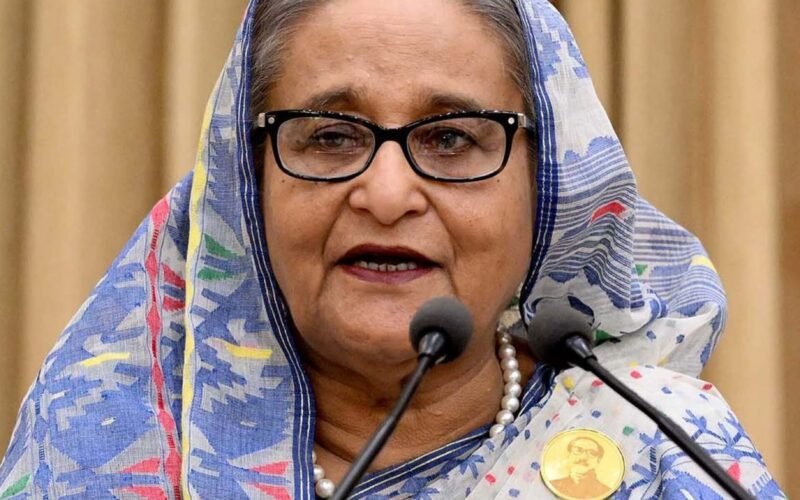
Mohammed Shahid Miah, The Journalistic News Desk: In her first major public address since fleeing to India following the mass uprisings of 2024, former Bangladeshi Prime Minister Sheikh Hasina appeared via a virtual audio conference with the Foreign Correspondents’ Club South Asia (FCC South). Joined by her son, Sajeeb Wazed Joy, Hasina delivered a scathing critique of the current administration, detailed a grim economic and security downturn in Bangladesh, and declared her unwavering intent to return to her homeland regardless of legal threats.
Speaking as both a five-time former Prime Minister and the daughter of the nation’s founding father, Bangabandhu Sheikh Mujibur Rahman, Hasina expressed profound gratitude to journalists covering Bangladesh under difficult circumstances.
A Defiant Stance on Returning to Bangladesh
Addressing her future and the possibility of facing arrest or trial upon her return, Hasina adopted a defiant tone, emphasizing that personal safety no longer dictates her actions.
”My life has long gone beyond calculations of personal security! Even the August 21 grenade attack in 2004 could not stop me. Therefore, I am not worried about my own future. I am worried about the future of Bangladesh.”
She stressed that her expected return is not merely about political power, but about restoring the country to its constitutional and democratic path:
- Commitment to the People: “I want to return to Bangladesh with a single purpose—to stand by the people and improve their lives… I know I may be detained, sent to prison, and attempts may be made to execute fabricated judgments. But fear can never determine my duty to the people.”
- Democratic Restoration: She maintained that her return and the reentry of the Awami League into the democratic process are essential to revive the nation’s development, secularism, and stability.
Reframing the 2024 July–August Uprising
Reflecting on the protests that led to her ouster, Hasina firmly rejected the characterization of the events as a purely peaceful student movement. Instead, she described it as a calculated, coordinated conspiracy designed to unseat her government through violence.
- The Quota Controversy: Noting that her government had successfully canceled the quota system back in 2018, she explained that the administration only appealed the 2024 High Court ruling to uphold that cancellation.
- Hijacked Intentions: Hasina claimed that organized groups exploited genuine student sentiments, turning legitimate grievances into a violent campaign demanding her single-point resignation. She cited instances of widespread arson, attacks on media outlets (including around 50 press offices), and massive infrastructure destruction targeting state assets like the BTV building, metro rail stations, and specialized hospitals.
- Law Enforcement Response: Defending the actions of security forces, Hasina noted that approximately 3,000 police personnel suffered severe violence, injuries, or death during the unrest, pointing out that the state had a fundamental obligation to protect public life and property against armed attacks.
A Grim Assessment of the Current Situation
Hasina painted a dark picture of present-day Bangladesh under the interim/subsequent leadership, warning that the nation is sliding backward into political terror, economic instability, and rising militancy.
- Political Persecution: She alleged that the suppression has continued long past August 5, 2024. According to her figures, nearly 650,000 people have been arrested, around 3,500 cases filed, and roughly 450,000 party members named alongside over a million unnamed individuals, with Hasina herself facing more than 600 cases. Female workers of the Awami League and its wings have faced systemic harassment and abuse in custody.
- Economic Freefall: Hasina highlighted a sharp reversal of the economic growth achieved during her 16-year tenure:
- GDP growth has reportedly dropped from 6.8% to 2.2%.
- Industrial growth has hit negative territory for the first time in 54 years.
- Non-performing bank loans have surged from 30% to 47%.
- Poverty rates have spiked from 18.6% to 46.8%, with over 20 million new unemployed citizens and more than 500 shuttered factories.
- Erosion of Liberation Values: Hasina condemned the targeting of cultural and historical symbols, specifically mentioning the attacks on Bangabandhu’s historic residence and museum at Dhanmondi 32, the release of convicted war criminals and militants, and the widespread targeting of minority communities.
Core Demands and International Appeal
Concluding her briefing, Hasina laid out a series of non-negotiable steps required to rescue Bangladesh from its current trajectory:
- Lift the ban on the Awami League.
- Release all political prisoners and drop false cases.
- Restore absolute freedom of speech, media independence, and judicial autonomy.
- Ensure law enforcement agencies operate in service of the citizens rather than for political victimization.
Appealing directly to the international community, she urged global partners and democratic nations to support the Bangladeshi people in their struggle for justice, rule of law, and peace, warning that a destabilized Bangladesh poses a regional threat to security and economic progress.
The briefing concluded with Hasina reaffirming her deep trust in the public, signing off with the traditional slogans: “”Joy Bangla, Joy Bangabandhu.”
Bangladesh Government and Public Reaction & Response
The virtual press briefing held by former Prime Minister Sheikh Hasina from New Delhi triggered an immediate, sharp backlash from the Government of Bangladesh, civil society, and the public.
Official Government Stance and Diplomatic Outrage
The Ministry of Foreign Affairs (MoFA) of Bangladesh issued a strongly worded statement expressing deep “outrage” and regret over the event:
- Affront to Sovereignty: Dhaka condemned the media interaction—deliberately timed around the anniversary of the 2024 uprising—as a direct insult to national sovereignty and a “grievous insult to the martyrs of the July Revolution”.
- Disappointment with New Delhi: The Bangladeshi government stated it had explicitly communicated its concerns to Indian authorities prior to the event regarding its potential to damage bilateral ties. Dhaka expressed frustration that India permitted the platform, calling it “detrimental to the development of harmonious bilateral relations”.
- Extradition Demands Reiterated: Highlighting that Hasina was convicted in absentia and sentenced to death by Bangladesh’s International Crimes Tribunal for crimes against humanity, the foreign ministry criticized India for failing to respond to repeated extradition requests under the 2013 bilateral Extradition Treaty.
- Rejection of Historical Revisionism: The government rejected Hasina’s claims regarding the 2024 uprising, labeling her statements a “futile attempt to rewrite history” and denying the well-documented UN findings concerning civilian and child casualties during the crackdown.