
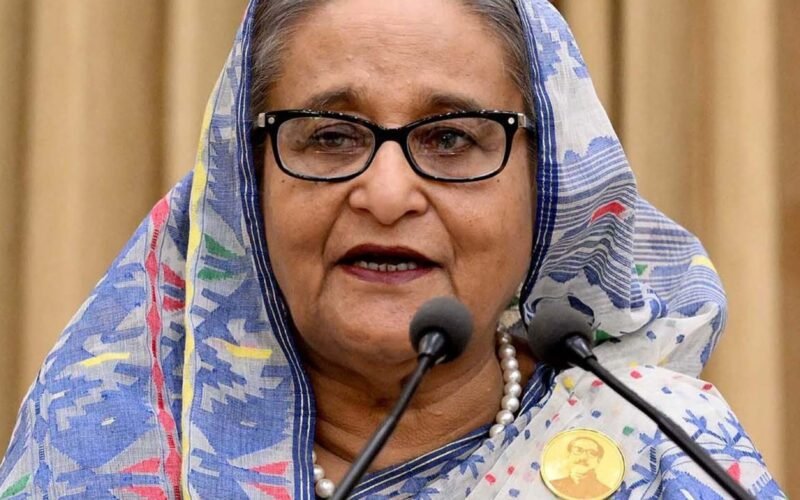
Former Prime Minister’s legal team approaches Bangladesh High Commission in New Delhi; proposed return could trigger major political, legal and diplomatic developments.
By Muslima Akhtar ||
DHAKA / NEW DELHI: Bangladesh’s ousted prime minister Sheikh Hasina has formally requested a new Bangladeshi passport and National Identity Card (NID), in what appears to be a significant step towards fulfilling her stated intention to return to Bangladesh in December after more than two years in exile in India.The request was submitted through her legal representatives to the Bangladesh High Commission in New Delhi. According to a letter seen by Reuters, Hasina’s London-based lawyers have asked the diplomatic mission to arrange the necessary travel and identification documents as quickly as possible.The development comes amid continuing political uncertainty in Bangladesh and growing diplomatic sensitivities between Dhaka and New Delhi over Hasina’s presence in India.Her proposed return is particularly significant because she faces a death sentence imposed in absentia by Bangladesh’s International Crimes Tribunal in November 2025 over allegations relating to the deadly suppression of the student-led uprising that brought an end to her government in August 2024.Hasina has consistently denied the allegations and described the proceedings against her as politically motivated.Legal team requests new travel documentsIn a letter addressed to Preeti Rahman, the acting high commissioner of Bangladesh in New Delhi, Hasina’s lawyers requested the issuance of a new Bangladeshi passport and National Identity Card.The legal representatives, from London-based Matrix Chambers, referred to the reported revocation of Hasina’s previous passport and NID by the former interim administration and relevant authorities.The lawyers argued that their client remains a Bangladeshi national and requested that the applications be processed in accordance with Bangladesh’s domestic laws and applicable international human rights obligations.They also asked the High Commission to clarify the formalities and documentation required to complete the applications.The request is notable because it represents a formal attempt by Hasina’s legal team to secure the documentation necessary for her proposed journey home.However, there has been no confirmation that the Bangladesh High Commission has approved the applications or agreed to issue the requested documents.Neither the diplomatic mission nor representatives of Prime Minister Tarique Rahman’s government had immediately provided a public response to the request when the reports emerged.
Hasina says she intends to return in December
Hasina has previously indicated that she intends to return to Bangladesh in December 2026, despite the legal consequences she could face upon arrival.She has reportedly told Reuters that she plans to return voluntarily and surrender before a court to contest the legal proceedings against her.Her aides have indicated that the precise date of her return will be announced once the necessary formalities have been completed.The passport and NID application therefore represents a potentially important practical step towards her stated intention.Hasina has been living in India since 5 August 2024, when she left Bangladesh following weeks of escalating demonstrations and a nationwide uprising against her government.Her departure marked the end of more than 15 consecutive years in power, following her earlier term as prime minister between 1996 and 2001.
Death sentence and allegations over 2024 crackdown
One of the biggest obstacles to Hasina’s return is the death sentence imposed by Bangladesh’s International Crimes Tribunal on 17 November 2025.The tribunal found her guilty of crimes against humanity in connection with the government’s response to the student-led protests of July and August 2024.Prosecutors alleged that Hasina and senior members of her administration were responsible for authorising or facilitating the use of lethal force against demonstrators.The charges included incitement, ordering killings and failing to prevent atrocities committed during the crackdown.Former home minister Asaduzzaman Khan was also sentenced to death in absentia in the same proceedings.Hasina rejected the allegations, questioned the legitimacy and fairness of the trial and maintained that she had not ordered the deliberate killing of protesters.The United Nations has estimated that as many as 1,400 people may have been killed during the violence between 15 July and 5 August 2024, with thousands more injured.The UN human rights office acknowledged the importance of accountability for victims but expressed opposition to the death penalty and raised concerns about the standards of a trial conducted in the defendant’s absence.Hasina’s possible return would bring her directly into the jurisdiction of the Bangladeshi authorities, where she would face the consequences of the existing judgment and any other outstanding legal proceedings.How Hasina lost powerThe political crisis that led to Hasina’s departure began with student demonstrations against the government job quota system.The protests initially focused on the reinstatement of a quota arrangement reserving a significant proportion of public-sector positions for particular groups, including descendants of participants in Bangladesh’s 1971 Liberation War.However, the demonstrations rapidly developed into a wider movement against Hasina’s government.Students, opposition supporters and other sections of society joined the protests, demanding political accountability, democratic reforms and an end to what they regarded as increasingly authoritarian government.The government’s response resulted in widespread violence, mass arrests and significant loss of life.On 5 August 2024, Hasina left Bangladesh and travelled to India as protesters gathered in Dhaka and the political situation became increasingly unstable.An interim administration led by Nobel Peace Prize laureate Muhammad Yunus subsequently took responsibility for governing the country during the transition.
Bangladesh has undergone another political transition
Bangladesh has since experienced another major political change.Following the interim administration, the country held parliamentary elections in February 2026, resulting in a decisive victory for the Bangladesh Nationalist Party (BNP), led by Tarique Rahman.The new administration inherited a politically divided country facing questions over accountability, economic stability, institutional reform and the future of the country’s democratic system.Hasina’s Awami League, which had dominated Bangladeshi politics for many years, was barred from participating in the election following the government’s action against the party.Several senior Awami League figures have been arrested, while others have remained outside Bangladesh.Hasina’s potential return could therefore reopen political disputes surrounding the party’s future, the treatment of its supporters and the question of whether former political leaders should be able to participate in the country’s democratic process.Her supporters continue to regard her as an important political figure, while critics hold her responsible for the repression and violence that occurred during her final years in office.India’s position could become increasingly sensitiveHasina’s continued presence in India has been a major source of diplomatic tension between the two neighbouring countries.Bangladesh has repeatedly sought her extradition, arguing that she should return to face justice.India has so far not handed her over.The issue is particularly sensitive because India and Bangladesh maintained close political, economic and security relations during Hasina’s years in power.Her departure to India in August 2024 fundamentally changed the diplomatic circumstances.New Delhi has faced the challenge of maintaining relations with Bangladesh’s successive administrations while dealing with the presence of a former Bangladeshi prime minister who remains a highly controversial political figure.If Hasina receives new travel documents and returns voluntarily, it could remove one important complication in the bilateral relationship.Nevertheless, her return would not automatically resolve the outstanding extradition dispute or the broader diplomatic tensions.What happens if Hasina returns?A return to Bangladesh could have immediate legal and political consequences.The existing death sentence, together with other pending cases, means Hasina would face serious legal challenges upon entering the country.Bangladesh’s government has previously indicated that she would be dealt with according to the law.The government has also made clear that her political position would not exempt her from the judicial process.Her return could raise several important questions:- Whether she would be taken into custody immediately upon arrival.- Whether she could pursue any available legal remedies against the tribunal’s judgment.- Whether her legal team would challenge the proceedings and seek further judicial review.- Whether other senior Awami League leaders currently outside Bangladesh would follow her example.- Whether her return would lead to renewed political demonstrations or further instability.The issue also raises wider questions about political reconciliation, the independence of the judiciary and the treatment of former government officials.For the families of those killed during the 2024 uprising, accountability remains a central demand. For Hasina and her supporters, the fairness and political legitimacy of the legal proceedings remain major concerns.A potentially defining moment for BangladeshHasina’s request for a new passport and NID does not guarantee that she will return in December. The approval of the documents, the position of the Bangladeshi government and the legal arrangements surrounding her return remain uncertain.Nevertheless, the formal approach to the Bangladesh High Commission represents a significant development in a political crisis that has continued to shape the country’s domestic and international affairs.If she follows through with her stated intention, Bangladesh could face one of the most consequential political and legal developments since the uprising of 2024.For a country still attempting to consolidate its political transition, the return of its former longest-serving prime minister would present an extraordinary test for its judicial institutions, political leadership and democratic future.The Journalistic will continue to monitor developments surrounding Sheikh Hasina’s proposed return, the passport application and the response from the Bangladesh government and Indian authorities.