

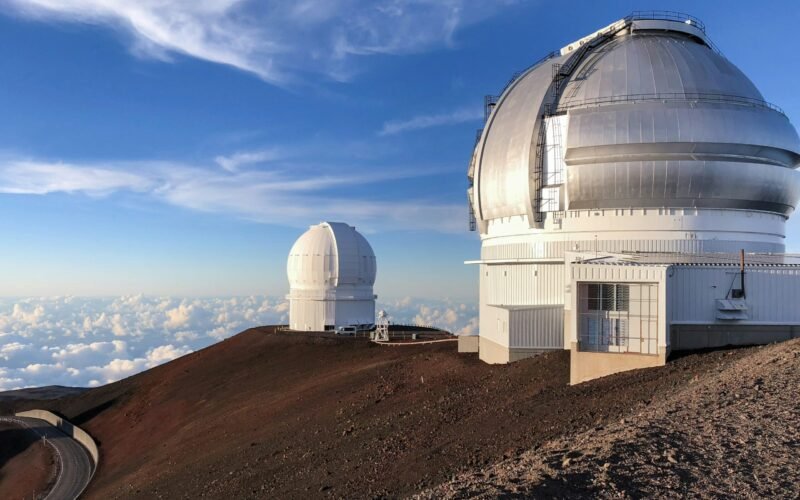
A new era of astronomy has officially begun as the Vera C. Rubin Observatory in northern Chile has started its ambitious 10-year Legacy Survey of Space and Time (LSST), a project expected to transform humanity’s understanding of the universe by producing the most detailed time-lapse record of the night sky ever assembled.
Perched atop Cerro Pachón beneath some of the world’s darkest and clearest skies, the observatory will repeatedly scan the southern sky over the next decade, capturing billions of stars, galaxies, asteroids and other celestial objects with an unprecedented combination of speed, depth and precision. According to the Associated Press, the telescope will photograph vast regions of the sky hundreds of times throughout the survey, allowing astronomers to observe how the universe changes over time rather than viewing it as a series of static snapshots.
At the heart of the observatory is the world’s largest digital camera, an engineering achievement weighing roughly three tons and equipped with a staggering 3,200-megapixel sensor. According to Space.com, the camera will capture ultra-high-definition images every few nights as it repeatedly surveys the southern hemisphere, ultimately creating what researchers describe as “the greatest cosmic movie ever made.”
The observatory has been designed to revisit each area of the southern sky around 800 times during its decade-long mission. This repeated imaging will allow scientists to detect subtle changes across the universe, from exploding stars and moving asteroids to distant galaxies evolving over billions of years. According to TechRadar, the camera will take an image approximately every 40 seconds during observing nights, generating an enormous stream of scientific data that will reshape astronomical research for decades.
Researchers expect the survey to produce around 10 terabytes of data every night, eventually accumulating one of the largest astronomical datasets ever collected. Sophisticated computing systems will process this information almost immediately, issuing millions of alerts whenever something changes in the night sky. These alerts will enable astronomers around the world to respond quickly to newly discovered supernovae, potentially hazardous asteroids and other short-lived cosmic events that might otherwise go unnoticed. According to TechRadar, the observatory could generate millions of these notifications each night, making it one of the most productive astronomical discovery machines ever built.
The Rubin Observatory’s scientific ambitions extend far beyond cataloguing celestial objects. According to the Associated Press, one of its primary goals is to improve scientists’ understanding of dark matter and dark energy, two mysterious components that together make up approximately 95 percent of the universe yet remain largely unexplained. By observing how galaxies form, cluster and evolve over cosmic time, researchers hope to uncover new evidence about these invisible forces and how they influence the structure and expansion of the universe.
The facility is named after pioneering American astronomer Vera C. Rubin, whose groundbreaking observations of galaxy rotation provided some of the earliest and strongest evidence for the existence of dark matter. Her work fundamentally changed modern astronomy, and the observatory bearing her name is expected to continue that legacy by addressing some of the biggest unanswered questions in cosmology.
According to Space.com, the observatory has already demonstrated its remarkable capabilities during early operations, discovering more than 11,000 previously unknown asteroids before the full survey officially began. Those discoveries included dozens of near-Earth asteroids as well as hundreds of distant objects beyond Neptune, highlighting the observatory’s potential to dramatically expand knowledge of our own Solar System alongside its exploration of the wider universe.
The Rubin Observatory’s rapid surveying ability is expected to revolutionise time-domain astronomy, the study of objects that change in brightness or position over time. By returning to the same regions of the sky repeatedly, astronomers will be able to monitor stellar explosions, black holes, variable stars, comets and countless other dynamic phenomena with a level of detail never before possible.
Beyond professional astronomy, the project has been designed to benefit researchers worldwide through an unprecedented commitment to data sharing. According to the Associated Press, scientists across the globe will have access to the observatory’s vast archive, allowing thousands of researchers to pursue discoveries using the same extraordinary dataset. The repeated observations are also expected to reveal countless objects too faint or too transient for previous surveys to detect.
The Rubin Observatory represents more than two decades of planning, engineering and international collaboration involving the U.S. National Science Foundation, the U.S. Department of Energy and numerous scientific institutions. According to Space.com, the launch of the full survey marks the beginning of what many astronomers believe will become one of the most influential observational projects in modern science, with discoveries likely to continue long after the decade-long survey has ended.
As the telescope begins recording its vast cinematic portrait of the universe, scientists anticipate not only answering longstanding questions about cosmic evolution but also uncovering entirely unexpected phenomena. With billions of celestial objects set to be observed repeatedly over the next ten years, the Rubin Observatory is poised to reshape astronomy and provide an enduring record of a constantly changing universe unlike anything humanity has ever assembled.