

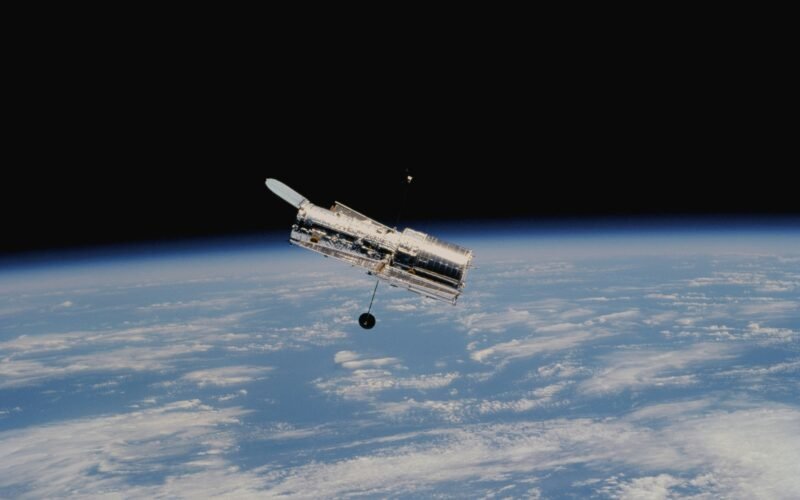
The James Webb Space Telescope has celebrated four years of scientific operations by unveiling spectacular new images of one of the sky’s most fascinating galaxies, offering astronomers an unprecedented look into the aftermath of an ancient galactic collision while highlighting the observatory’s extraordinary ability to uncover details that have remained hidden for decades.
The anniversary release focuses on Centaurus A, also known as NGC 5128, a peculiar galaxy located approximately 11 million light-years from Earth in the constellation Centaurus. Its unusual appearance is the result of a dramatic merger between two galaxies that occurred roughly two billion years ago, leaving behind a chaotic system filled with dust, newly formed stars and an active supermassive black hole. According to Space.com, the anniversary image demonstrates how Webb continues to reveal the hidden processes that shape galaxies long after such cosmic collisions have taken place.
Since beginning science operations in July 2022, the James Webb Space Telescope has transformed modern astronomy by observing some of the earliest galaxies ever formed, analysing the atmospheres of distant exoplanets and revealing intricate details of stellar nurseries throughout the universe. The latest anniversary images continue that tradition by focusing on a nearby galaxy whose proximity allows scientists to study galactic evolution in exceptional detail.
Unlike visible-light telescopes, Webb observes primarily in infrared wavelengths, enabling it to peer through dense clouds of dust that normally obscure the centres of galaxies. According to the Associated Press, the observatory has repeatedly demonstrated this capability throughout its mission, providing scientists with clearer views of regions that were previously impossible to examine using older space telescopes.
The new observations combine data from Webb’s Near-Infrared Camera (NIRCam) and Mid-Infrared Instrument (MIRI), producing one of the most detailed portraits ever assembled of Centaurus A. According to Digital Camera World, the infrared observations expose a warped, parallelogram-shaped band of dust and stars surrounding the galaxy’s core, along with delicate streams of material left behind by the long-ago merger that continue to influence the galaxy’s structure today.
Centaurus A has long attracted astronomers because it contains an actively feeding supermassive black hole at its centre. Vast amounts of gas and dust continue to spiral toward the black hole, producing enormous amounts of energy and launching jets of high-speed particles far into intergalactic space. Webb’s enhanced sensitivity has allowed researchers to examine these complex regions with unprecedented clarity, revealing interactions between gas, dust and newly forming stars that were previously hidden from view.
According to Space.com, the observations show how the galaxy’s central black hole appears to play two contrasting roles at the same time. While powerful outflows generated by the black hole can compress surrounding gas and trigger the birth of new stars in some regions, they also heat or disperse gas elsewhere, preventing star formation from taking place. This delicate balance helps astronomers better understand how black holes regulate the long-term evolution of galaxies.
One of the most intriguing discoveries in the anniversary images is a mysterious S-shaped feature near the galaxy’s centre. Scientists have not yet determined exactly what created this unusual structure, but it may be connected to the motion of gas following the ancient collision or interactions involving the energetic jets emerging from the central black hole. According to Digital Camera World, the unexpected feature highlights how even well-studied galaxies continue to produce new scientific puzzles when viewed with Webb’s powerful instruments.
The observatory’s infrared vision also resolves millions of individual stars scattered throughout Centaurus A, allowing researchers to trace regions where stars are continuing to form from clouds of gas left behind after the merger. These observations provide an important record of how galaxies rebuild themselves following violent collisions, offering clues about the processes that have shaped countless galaxies across cosmic history.
Although Webb often makes headlines for discovering galaxies that existed only a few hundred million years after the Big Bang, scientists say nearby galaxies such as Centaurus A are equally valuable research targets. Their relative closeness allows astronomers to study physical processes in far greater detail, improving theories that can later be applied to understanding much more distant galaxies observed earlier in the universe’s history.
According to the Associated Press, the anniversary images also celebrate four years of scientific achievements that have consistently exceeded expectations. Since its launch on Christmas Day 2021 and the release of its first science images in 2022, Webb has rewritten astronomy textbooks by identifying some of the earliest known galaxies, investigating planetary systems beyond our own and providing fresh insight into the origins of stars, galaxies and black holes.
The telescope represents a collaboration between NASA, the European Space Agency and the Canadian Space Agency, and continues to operate from its position approximately one million miles from Earth near the Sun-Earth L2 Lagrange point. From there, its large segmented mirror and sophisticated infrared instruments are able to observe the universe with extraordinary sensitivity while remaining shielded from the Sun’s heat.
Scientists expect the James Webb Space Telescope to continue operating for many years beyond its original mission goals, with every observing cycle producing discoveries that challenge existing theories and open entirely new areas of research. According to Space.com, the latest images of Centaurus A demonstrate that even familiar galaxies still contain hidden structures waiting to be uncovered, ensuring that Webb remains one of the most important scientific instruments ever built. As it begins its fifth year of science operations, the observatory continues to provide astronomers with an increasingly detailed picture of how the universe has evolved from its earliest moments to the richly complex cosmos seen today.