

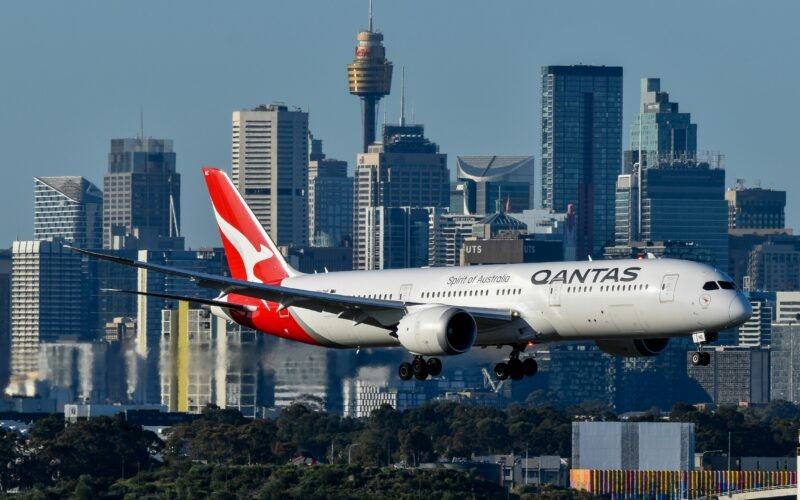
Western Sydney International Airport has reached a major milestone on its journey toward becoming Australia’s newest aviation hub after a Qantas Freight aircraft became the first plane to land at the airport’s new cargo precinct, marking the beginning of final operational trials ahead of the commencement of regular freight services later this month.
The arrival of the Airbus A321 freighter on July 13 represents the first aircraft to use the airport’s purpose-built cargo facilities and signals the transition from years of construction into the final stages of operational readiness. The milestone comes just months before the airport is due to welcome its first scheduled passenger services, completing one of Australia’s largest transport infrastructure projects in decades.
According to News.com.au, Qantas flight QF7301 touched down at approximately 2 p.m. after overcoming unexpected delays caused by severe weather near Shanghai and a late aircraft substitution following a technical issue. Although the flight arrived around 90 minutes later than originally planned, the successful landing was greeted as a landmark achievement for Western Sydney International Airport, which is preparing to open to commercial freight operations later in July.
The flight formed part of an extensive testing programme designed to ensure every aspect of cargo operations functions smoothly before commercial services begin. Rather than transporting freight as part of a normal scheduled operation, the aircraft was used to validate critical procedures across the airport’s new logistics facilities, allowing operational teams to assess aircraft handling, cargo movements, communications systems and coordination between multiple organisations working throughout the precinct.
According to Travel Weekly, the trial marks one of the final phases of Western Sydney International’s operational readiness programme, with airport staff planning additional test flights over the coming weeks before the first regular freight services commence on July 27. Airport chief executive Simon Hickey said the trials are intended to “bring this airport to life” while ensuring every operational process performs as expected before the official opening of the cargo hub.
The new cargo precinct has been designed as a 24-hour freight operation, giving airlines and logistics companies an alternative to Sydney Kingsford Smith Airport, where overnight aircraft movements are restricted by curfew regulations. Industry experts believe the new facility will significantly increase freight capacity for Australia’s largest city while improving the movement of time-sensitive goods throughout domestic and international supply chains.
According to The Australian, Qantas Freight expects more than 850 tonnes of cargo to pass through its new terminal each week once scheduled services begin. The airline will operate from a modern 24,000-square-metre freight terminal that has been purpose-built to support faster and more efficient handling of parcels, perishables, medical supplies and other high-value freight moving across Australia and overseas.
The Qantas Airbus A321 freighter was selected for the inaugural trial because it represents an increasingly important part of the airline’s domestic freight network. Converted from a former passenger aircraft, the narrow-body freighter offers an efficient solution for transporting cargo between major Australian cities while supporting the continued growth of online retail and express parcel deliveries.
Airport officials view the first landing as far more than a symbolic occasion. Every element of the operation, from aircraft parking and unloading procedures to security screening, ground handling, communications and vehicle movements, was carefully monitored throughout the trial. The information gathered will help engineers and operational teams fine-tune procedures before the airport begins serving customers on a daily basis.
According to Travel Weekly, additional readiness exercises are planned during the remainder of July as Western Sydney International continues preparing both its cargo facilities and broader airport infrastructure for full commercial operations. The testing programme is intended to ensure staff, equipment and airport systems are fully integrated before freight services become routine.
The cargo precinct is expected to play a major role in strengthening Sydney’s logistics network. Unlike passenger terminals, freight facilities often operate continuously throughout the day and night, allowing goods to move more quickly between manufacturers, distribution centres and retailers. The airport’s location in Western Sydney also places it close to many of Australia’s largest warehousing and industrial districts.
According to News.com.au, the airport has been designed with significant room for expansion. It is expected to handle around 220,000 tonnes of freight annually during its initial phase, while future development plans could eventually increase capacity to as much as two million tonnes each year as demand grows. That scalability is expected to support the region’s long-term economic development and strengthen Australia’s international trade connections.
The successful landing also demonstrates the progress made since major changes were introduced to Sydney’s airspace to accommodate operations at the new airport. Those changes, described by aviation authorities as the most significant redesign of Sydney’s airspace in half a century, will allow Western Sydney International and Sydney Kingsford Smith Airport to operate simultaneously while maintaining safe and efficient aircraft movements.
Beyond freight, the airport is preparing for the arrival of passenger services later this year. Jetstar is scheduled to operate the airport’s inaugural passenger flight on October 25, followed by Air New Zealand the following day and Singapore Airlines later in November. Qantas mainline passenger services are expected to begin in March 2027, expanding the airport’s role within Australia’s aviation network.
According to The Australian, Western Sydney International will also introduce several technological innovations, including Australia’s first fully digital air traffic control tower, enabling controllers to manage aircraft movements using advanced high-definition camera systems and digital displays rather than relying solely on traditional visual observation from a conventional control tower.
For Qantas Freight, the inaugural landing marks the beginning of a new chapter in the airline’s cargo operations. For Western Sydney International Airport, it represents tangible evidence that years of planning, construction and testing are approaching their conclusion. As additional trial flights continue and commercial freight services prepare to begin, the successful arrival of the first Qantas freighter demonstrates that Australia’s newest international airport is rapidly moving from construction project to fully operational aviation gateway, one that is expected to play a growing role in both passenger travel and air cargo for decades to come.