

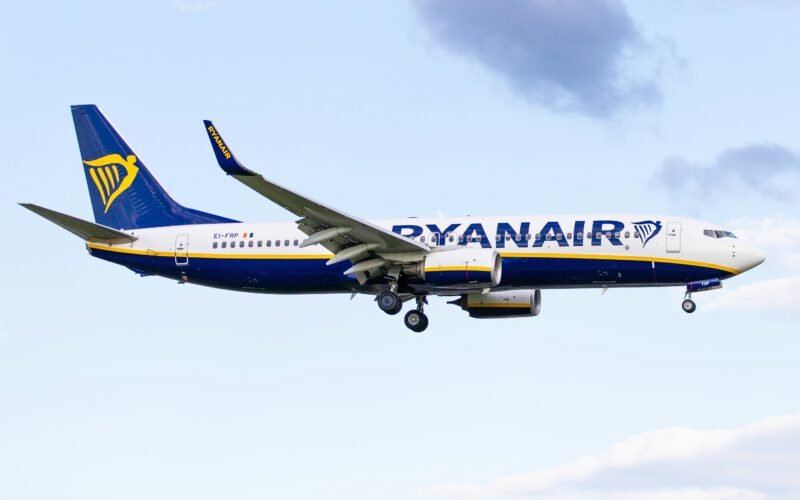
The European Union Aviation Safety Agency (EASA) has launched its own investigation into the dramatic Ryanair window incident that forced an emergency landing in Greece, appointing a technical adviser to examine the circumstances surrounding one of the most serious in-flight safety events involving a European commercial airline in recent years.
The move follows the July 10 incident aboard a Ryanair-operated Boeing 737-800, flown by the airline’s Maltese subsidiary, Malta Air, during a scheduled flight from Thessaloniki, Greece, to Memmingen, Germany. Shortly after take-off, a passenger window failed, causing rapid cabin depressurisation and partially pulling a passenger through the opening before fellow travellers managed to pull him back inside the aircraft.
According to Reuters, EASA announced on July 13 that it had appointed a technical adviser to support the investigation, with the regulator seeking to determine exactly why the window failed and whether any broader safety recommendations should be made once investigators complete their work. The agency said its objective is to establish the causes of the incident and help prevent similar events from occurring in the future.
The flight crew declared an emergency and immediately turned the aircraft back toward Thessaloniki, where it landed safely. Emergency services met the aircraft on arrival, while passengers were escorted back to the terminal. According to Reuters, the injured passenger, a Serbian national, was taken to AHEPA University General Hospital with injuries that were not considered life-threatening. Doctors later assessed the extent of his injuries while the remainder of the passengers were accommodated following the emergency landing.
The incident quickly attracted worldwide attention because of eyewitness accounts describing the terrifying moments after the window failed. According to The Guardian, reports from passengers indicated that the injured man’s wife held onto his legs while other passengers and crew members helped pull him back into the cabin after his head and shoulders were forced outside the aircraft by the sudden rush of air. Those accounts have not been independently verified by investigators but illustrate the dramatic nature of the emergency experienced by those onboard.
Investigators are now working to determine what caused the window to break. Initial reports cited by Reuters suggested the aircraft may have suffered an uncontained engine failure shortly after departure, with debris potentially striking the cabin window and causing the depressurisation. However, officials have emphasised that the precise sequence of events has yet to be confirmed and remains under investigation. Boeing, whose 737 Next Generation aircraft was involved, has said it is assisting investigators while remaining in contact with Ryanair. The U.S. Federal Aviation Administration has also indicated it is prepared to support the inquiry if required.
The aircraft involved is a Boeing 737-800 powered by CFM56 engines, one of the most widely used narrow-body passenger aircraft in commercial aviation. According to Reuters, flight-tracking data showed the aircraft returned to Thessaloniki only minutes after departure, while the damaged jet remained grounded following the incident to allow investigators to conduct detailed technical inspections.
The investigation is expected to involve cooperation between several national and international authorities. EASA’s participation adds a European regulatory dimension to the inquiry alongside the national accident investigation authorities already examining the event. According to Reuters, EASA’s technical adviser will provide specialist expertise as investigators analyse physical evidence, maintenance records and operational data to determine exactly what led to the window failure.
Attention has also turned to the aircraft’s recent operational history. According to Reuters, the same aircraft had reportedly returned to Thessaloniki during another flight the previous day, although investigators have not established any connection between that earlier diversion and the subsequent emergency involving the broken window. Whether the two events are related remains one of many questions investigators will examine during the inquiry.
The dramatic incident has inevitably drawn comparisons with a fatal accident involving a Southwest Airlines Boeing 737-700 in the United States in 2018. In that case, an engine fan blade failure caused debris to shatter a cabin window, resulting in explosive decompression and the death of a passenger who was partially pulled from the aircraft. According to Reuters, that accident prompted recommendations from the U.S. National Transportation Safety Board for Boeing to redesign elements of the engine fan cowl, while the FAA later issued directives requiring modifications to affected aircraft. Investigators have stressed that it is too early to conclude whether the Ryanair incident bears any technical similarity to the earlier accident.
The Irish Times reported that Ryanair confirmed the aircraft returned to Thessaloniki after a cabin window became dislodged shortly after take-off, leading to the precautionary emergency landing. The airline has said the aircraft landed normally and passengers were safely returned to the terminal, while apologising for the disruption caused by the unexpected event.
For EASA, the investigation represents an opportunity to examine whether the incident was caused by an isolated mechanical failure, an issue involving maintenance, damage from engine debris or another factor entirely. The agency’s findings could ultimately influence future inspection procedures, maintenance requirements or operational guidance if investigators identify wider safety implications.
Although serious in-flight depressurisation events remain extremely rare in modern commercial aviation, the Ryanair emergency has highlighted the importance of multiple layers of aircraft safety systems, well-rehearsed emergency procedures and rapid crew responses. As investigators continue analysing the aircraft and reviewing flight data, aviation experts say the inquiry’s conclusions will be closely watched throughout the airline industry, with the goal of ensuring that any lessons learned contribute to maintaining the exceptionally high safety standards expected across European commercial aviation.