
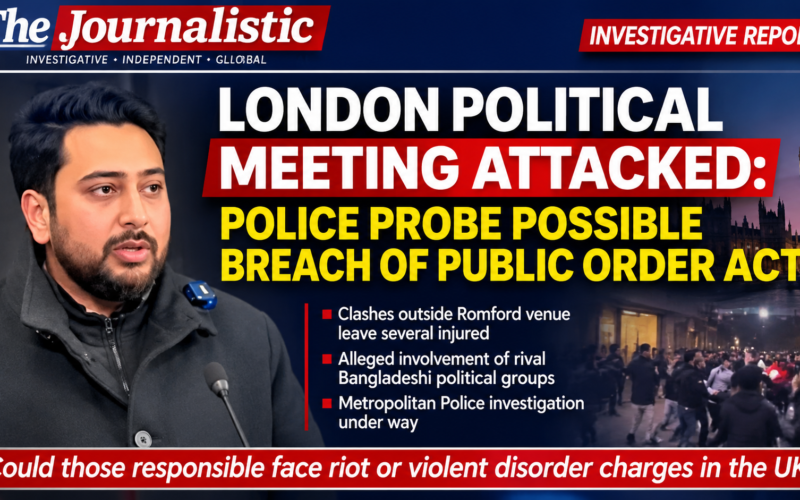
East London, United Kingdom :
A political meeting turns into a street confrontation
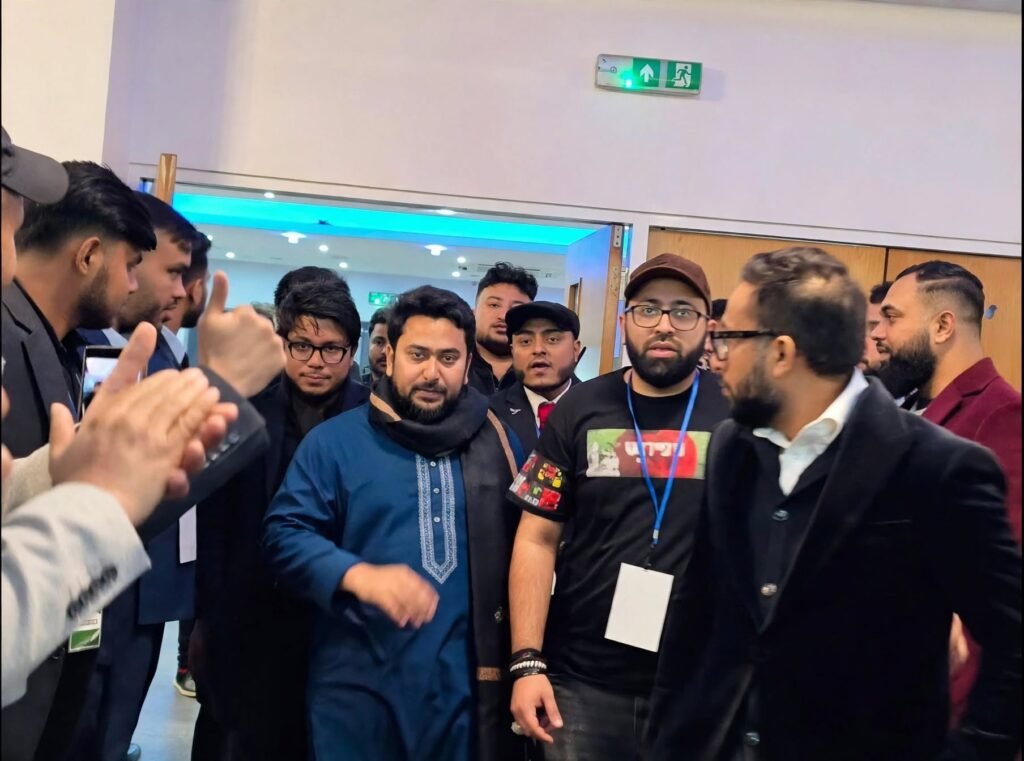
A political reception organised for Bangladeshi National Citizen Party (NCP) Convener and Opposition Chief Whip Nahid Islam in East London has ended in scenes of violence, raising serious questions about public order, political intimidation and the safety of the British-Bangladeshi community.
The incident took place on Monday, 16 November 2026, outside the Mayfair Venue on the High Road in the Romford and Chadwell Heath area of East London.
The event was organised by members of the British-Bangladeshi community to provide an opportunity for supporters, community representatives and political activists to meet Nahid Islam during his visit to the United Kingdom.
However, what should have been a peaceful political and community gathering was overshadowed by a confrontation involving people reportedly associated with rival Bangladeshi political groups.
According to media reports, supporters of the Awami League had gathered outside the venue while the NCP reception was taking place. Tensions reportedly escalated when attendees were leaving the premises.
Reports describe people throwing eggs, bottles and other objects, while videos circulating on social media appear to show individuals carrying sticks and engaging in physical confrontations.
The violence reportedly spread onto nearby residential streets, causing concern among local residents.
What happened outside the venue?
The Metropolitan Police confirmed that officers were called to High Road, Romford, at 9:59pm on 16 November following reports of a disturbance.
According to the police statement, approximately 50 men had been taking part in a protest before violent disorder occurred.
Officers attended alongside the London Ambulance Service. Three people were taken to hospital, although their injuries were not considered life-threatening or life-changing.
The London Ambulance Service separately confirmed that two ambulance crews attended and treated six patients.
Other media reports have given different figures for the number of injured people. Prothom Alo reported five people receiving hospital treatment, while other accounts suggested a higher number of injuries.
The precise total remains to be independently established.
The Metropolitan Police confirmed that an investigation was ongoing and that no arrests had been made at the time of its statement.
The police have appealed for witnesses and people with CCTV or dashcam footage to assist the investigation.
Who was responsible?
The National Citizen Party has accused individuals associated with the Awami League and its affiliated organisations of attacking people attending the reception.
Nahid Islam also condemned the incident in a statement published through his verified social media account, describing the reported violence as an attack on ordinary expatriate Bangladeshis and students.
The Awami League’s alleged involvement has been reported by several Bangladeshi media outlets. However, the police have not publicly established the identity or political affiliation of those responsible.
It is important to distinguish between allegations made by political representatives, eyewitness accounts and findings established through a criminal investigation.
Political affiliation alone does not establish criminal responsibility. Any individual accused of an offence is entitled to a fair investigation and the presumption of innocence.
THE LEGAL QUESTION: HAS THE PUBLIC ORDER ACT 1986 BEEN BREACHED?
One of the most important questions arising from the incident is whether the conduct of those involved could amount to offences under the Public Order Act 1986.
The legislation provides specific criminal offences dealing with serious public disorder, including riot, violent disorder and affray.
The available reports describe a gathering of approximately 50 protesters followed by physical confrontations, injuries and the use of objects including sticks and bottles.
If the evidence establishes that individuals participated in unlawful violence, prosecutors could consider the following offences.
1. Section 2 – Violent disorder
Section 2 of the Public Order Act 1986 makes it an offence where three or more people present together use or threaten unlawful violence and their collective conduct is such that it would cause a person of reasonable firmness to fear for their personal safety.
The offence does not require proof that the participants had organised themselves under a formal agreement or political organisation.
Nor is it necessary for all participants to use violence simultaneously.
The reported circumstances outside the Mayfair Venue could justify police and prosecutors examining whether this offence has been committed.
The maximum penalty on conviction on indictment is five years’ imprisonment.
2. Section 1 – Riot
Riot is a more serious offence.
Section 1 requires at least 12 people to be present together, using or threatening unlawful violence for a common purpose, in circumstances that would cause a person of reasonable firmness to fear for their personal safety.
Importantly, simply having 12 or more people at a demonstration does not constitute riot.
The prosecution must establish the statutory requirements, including the common purpose and the defendant’s own participation in unlawful violence.
The maximum penalty for riot is ten years’ imprisonment.
Given the reported presence of approximately 50 people, investigators may need to establish whether the evidence supports consideration of this offence.
However, the number of people reported at the protest does not establish that 12 or more committed riot.
3. Section 3 – Affray
Affray involves using or threatening unlawful violence towards another person in circumstances that would cause a person of reasonable firmness to fear for their personal safety.
It may apply where the evidence does not establish the necessary requirements for riot or violent disorder.
The maximum penalty on conviction on indictment is three years’ imprisonment.
Could individuals face assault and other criminal charges?
The Public Order Act is not the only legislation potentially relevant to the incident.
Depending on the evidence and the injuries suffered, police and prosecutors could also consider:
- Common assault or battery.
- Section 47 of the Offences Against the Person Act 1861, where an assault causes actual bodily harm.
- Section 20 of the Offences Against the Person Act 1861, where grievous bodily harm is unlawfully inflicted.
- Criminal damage, if property was deliberately damaged.
- Possession of an offensive weapon, if the legal requirements of the relevant offence are established.
Where serious assaults occur during public disorder, prosecutors may consider bringing both public order and assault charges where legally appropriate.
The use of sticks, bottles or other objects during a confrontation may be relevant evidence, but the precise circumstances and intentions of each individual must be examined.
Could the organisers also face criminal consequences?
An important aspect of this investigation is whether the violence was spontaneous or whether any individuals organised, encouraged, coordinated or deliberately facilitated it.
Police should examine:
- Whether there was prior planning or coordination.
- Whether individuals communicated before the incident.
- Whether there was evidence of instructions to attack or intimidate attendees.
- Whether any individuals encouraged or directed violence.
- Whether weapons or objects were brought to the location in anticipation of violence.
- Whether CCTV, mobile phone footage and witness statements identify those involved.
An organiser is not automatically criminally responsible merely because a person attending a protest commits an offence.
However, anyone who intentionally assists, encourages or participates in criminal violence may face criminal liability where the relevant legal requirements are established.
The investigation should therefore examine individual conduct and any available evidence of coordination rather than relying solely on political membership or association.
What could happen to those convicted?
The consequences of a criminal conviction could be significant.
Imprisonment
Individuals convicted of serious public order offences could receive custodial sentences, depending on the seriousness of the offence, their individual involvement, previous convictions and the sentencing guidelines.
Criminal record
A conviction could result in a criminal record, potentially affecting employment, professional registration, travel and other opportunities.
Compensation and financial consequences
Courts may impose compensation orders and other financial penalties where appropriate.
Immigration consequences
For individuals who are not British citizens, a criminal conviction could have immigration implications.
Under the UK Borders Act 2007, certain convictions can trigger automatic deportation provisions, subject to statutory conditions and exceptions.
Other immigration consequences may also arise depending on the person’s immigration status, sentence, criminal history and individual circumstances.
However, deportation is not automatic for every public order conviction, and British citizens cannot be deported from the United Kingdom.
Future travel and international consequences
A serious conviction may also affect visa applications, travel permissions and background checks in other countries.
Could the incident affect freedom of political expression in Britain?
The United Kingdom protects freedom of expression and peaceful assembly under domestic law and the European Convention on Human Rights.
Articles 10 and 11 protect freedom of expression and freedom of peaceful assembly.
These protections apply to political supporters, opponents, journalists, community organisations and ordinary members of the public.
People have the right to organise a political meeting, criticise a political leader, express disagreement and hold a peaceful demonstration outside a venue.
However, these rights do not provide permission to assault people, threaten violence or intimidate individuals into abandoning a political meeting.
The distinction is fundamental.
A peaceful protest against Nahid Islam or the NCP would be a legitimate form of political expression. An unlawful physical attack on meeting attendees would be an entirely different matter.
The law must protect both the right to protest and the right to participate in a lawful political gathering without fear of violence.
Bangladesh’s government responds
The incident has also attracted a response from Bangladesh’s Ministry of Foreign Affairs.
According to bdnews24, the ministry condemned the reported violence and called on the relevant British authorities to conduct a thorough investigation, identify those responsible and bring them to justice under British law.
The statement emphasised that Bangladeshi citizens should not face violence or intimidation while exercising democratic rights abroad.
The diplomatic response demonstrates that the incident has developed beyond a local dispute between political groups.
Nevertheless, the responsibility for investigating alleged criminal offences committed in London rests with the relevant British authorities.
Consequences for the British-Bangladeshi community
The incident raises concerns extending beyond the individuals directly involved.
British Bangladeshis have built businesses, community organisations, educational institutions, charities and political networks over several decades.
London and other British cities have long provided spaces where people of different political opinions can organise meetings and express their views.
When political disagreements from another country turn into physical confrontations on British streets, the consequences can affect the wider community.
Local residents may feel intimidated. Community organisations may become reluctant to host political events. Venue operators may introduce additional security requirements. Public confidence in the ability of community leaders to maintain peaceful gatherings may also be affected.
There is another concern.
Violent incidents involving members of an ethnic minority can be exploited by individuals seeking to promote hostility towards wider immigrant communities.
It would be wrong to hold an entire nationality or ethnic community responsible for the actions of particular individuals.
Criminal responsibility must remain individual.
The British-Bangladeshi community should not be collectively judged by an incident involving people who may have acted unlawfully.
What should the Metropolitan Police investigate?
A thorough investigation should establish the sequence of events before, during and after the confrontation.
In particular, investigators should consider:
- Reviewing CCTV from the venue, surrounding businesses and nearby residential properties.
- Examining mobile phone footage and videos circulated on social media.
- Identifying individuals allegedly carrying sticks, bottles or other objects.
- Taking statements from injured people, witnesses, journalists and event attendees.
- Establishing whether any individuals were deliberately targeted because of their political beliefs.
- Investigating whether there was prior coordination or encouragement of violence.
- Identifying the individuals responsible for particular assaults and acts of intimidation.
Police should also establish whether the confrontation involved one group attacking another, violence by individuals on both sides, or a sequence of separate incidents.
This is essential for a fair and evidence-based prosecution.
The role of the British authorities
The local police, Crown Prosecution Service and relevant public authorities have important responsibilities.
The Metropolitan Police must establish what happened and gather admissible evidence.
The Crown Prosecution Service must independently assess whether there is sufficient evidence and whether prosecution is in the public interest.
The courts must determine guilt based on evidence and the applicable law.
Political pressure, public outrage and diplomatic statements must not replace the criminal justice process.
At the same time, the authorities should ensure that British residents and visitors can participate in lawful political events without intimidation or violence.
Political differences must not become street violence
The events outside the Mayfair Venue raise serious questions about political tolerance, public safety and the rule of law.
The United Kingdom is a country where people are free to support different political parties, criticise governments and challenge political leaders.
Those freedoms belong to everyone, regardless of nationality, background or political affiliation.
But the right to protest does not include the right to attack others.
If the reported violence is established through evidence, those responsible could face serious criminal consequences, potentially including prosecution for violent disorder, affray, assault or, if the statutory requirements are satisfied, riot.
The investigation must be impartial. It must identify individuals rather than assign collective blame to a political organisation or an entire community.
The message should be clear: political disagreements must be resolved through debate, peaceful protest and democratic participation, not through violence on British streets.
The rule of law must apply equally to everyone.